


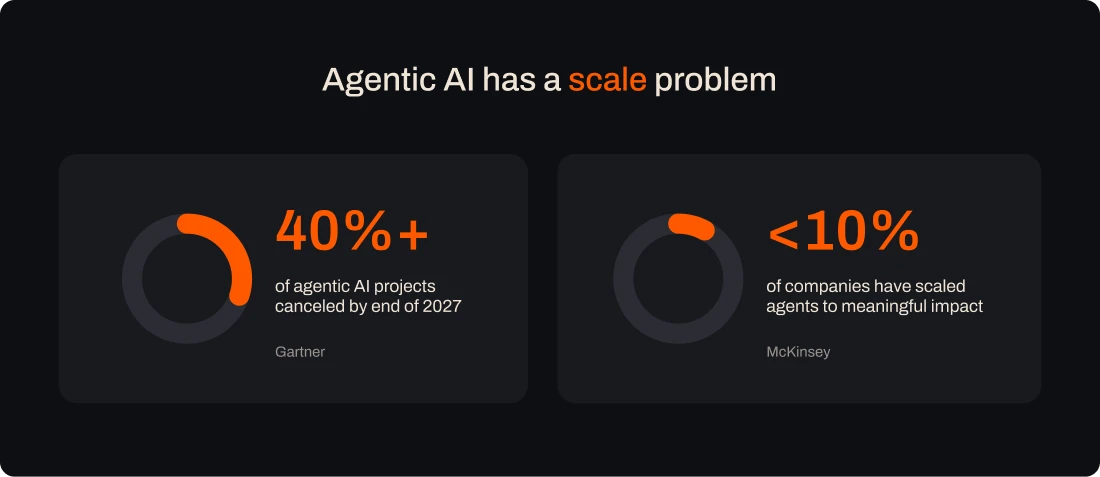
Gartner expects more than 40% of agentic AI projects to be canceled by the end of 2027. Its reasons read like a budget memo: escalating costs, unclear business value, and inadequate risk controls.
For revenue leaders, the stakes run in both directions. MGI Research estimates that at least 3% to 5% of revenue leaks between contract and cash, through missed renewals, unbilled usage, and pricing errors. Agents are well suited to close those gaps. Yet McKinsey finds fewer than 10% of companies have scaled agents to meaningful impact.
Most of these programs clear the demo and stall at the first P&L review, when the CFO asks what each agent earns after every production cost is counted. This article answers the question a CRO, CFO, or COO brings to that review: which agent investments deserve more funding, and what evidence proves it?
Why Do Agentic AI Projects Fail the P&L Review?
A pilot budget covers the model. Production adds the cost of running it as an operation, which we call the autonomy tax: every cost an agent adds once it acts on live accounts, contracts, and invoices.
- Run cost at volume. Retries, longer context, tool calls, and memory raise inference spend as workflows multiply.
- Exception handling. People still review low-confidence decisions, high-value accounts, and policy conflicts.
- Observability and evaluation. Every action needs a trace, and every policy or pricing change needs a new round of testing.
- Access and security. Agents that read contracts and write to CRM or billing systems need scoped permissions and audit trails.
- Integration upkeep. CRM, CPQ, billing, and ERP schemas change, and each change can break an agent.
The metric that survives a CFO review is contribution per completed workflow: the value each renewal saved, quote approved, or dispute resolved creates, minus its fully loaded cost. Token cost alone misses these line items.
Which Revenue Workflows Can Carry The Cost Of Autonomy?
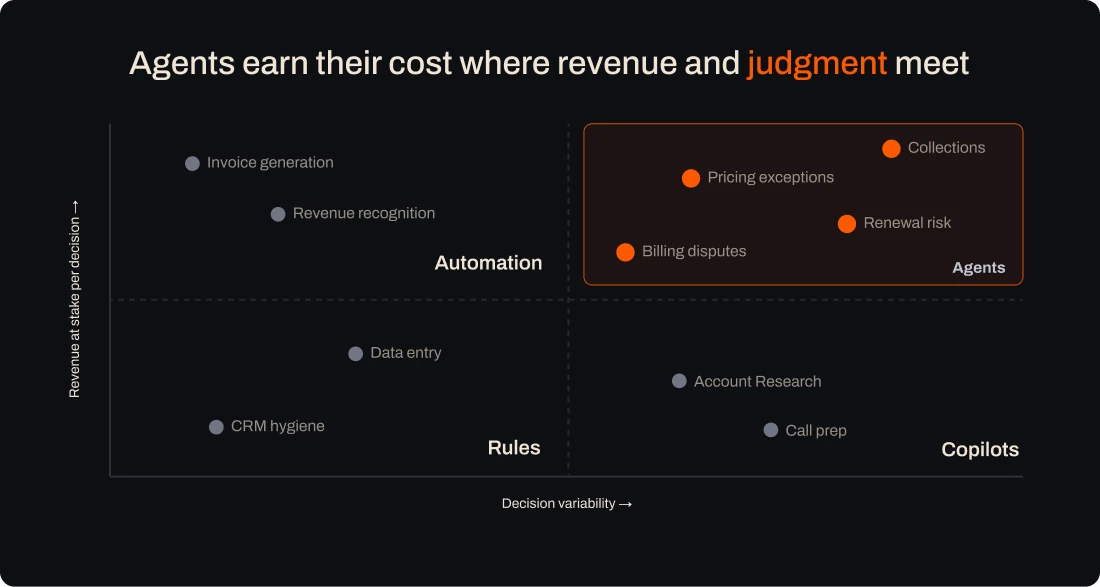
Gartner warns that many use cases positioned as agentic do not need an agentic implementation. The screen that matters for revenue operations uses two questions: how much revenue rides on each decision, and how much the right decision varies by account, contract, or context.
- High stakes, high variability: deploy agents. Renewal risk triage, deal desk pricing exceptions, usage billing disputes, and collections prioritization.
- High stakes, low variability: automate with hard controls. Invoice generation and revenue recognition rules need accuracy more than judgment.
- Low stakes, high variability: use copilots. Account research and call preparation help sellers without acting on their behalf.
- Low stakes, low variability: use rules. CRM hygiene and data entry rarely justify an agent's operating cost.
Why Should The Workflow Change Before The Agent Arrives?
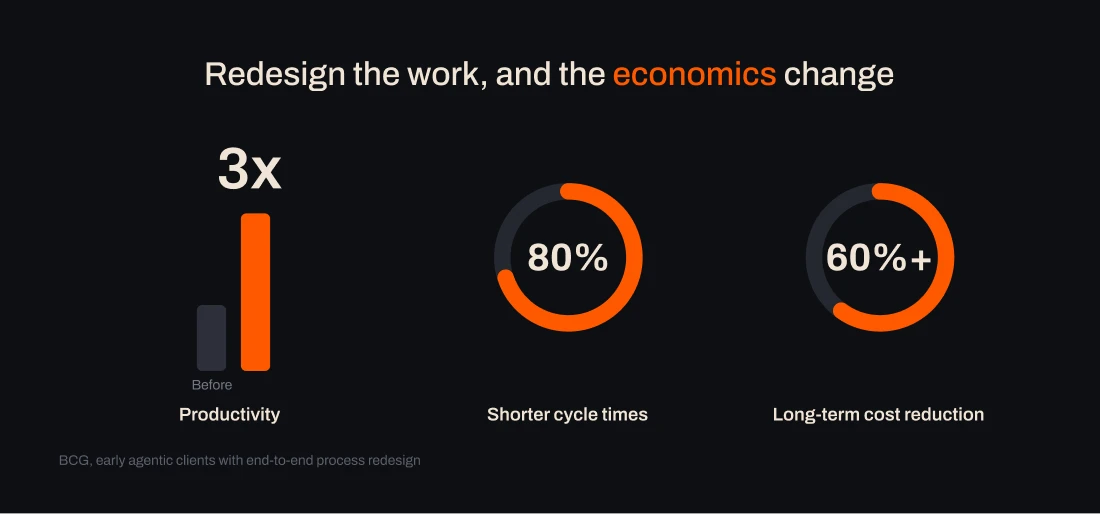
An agent inserted into a human-designed process inherits its queues, handoffs, and duplicate approvals. BCG reports that its first agentic clients, which redesigned processes end to end, are seeing a threefold productivity increase, 80% shorter cycle times, and long-term cost reductions of 60% or more.
Take a typical enterprise renewal. A customer success manager pulls usage data, finance checks billing history, the deal desk approves a discount, and legal reviews terms. Redesigned for agents, one workflow assembles that context, proposes the offer within policy, and routes only true exceptions to people.
For each revenue workflow, leaders should sort every decision into four groups:
- Delegate to the agent within defined limits.
- Keep with a named human owner.
- Eliminate where the step exists only to coordinate people.
- Escalate when value, risk, or policy conflict crosses a threshold.
A business owner, usually the CRO or head of revenue operations, should own the redesigned workflow and its outcomes.
How Much Authority Should a Revenue Agent Get?
Gartner predicts that by 2027, 40% of enterprises will demote or decommission autonomous agents after governance gaps surface in production incidents. Its prescription is proportional governance, with controls set by each agent's autonomy level. Applied to revenue operations, that becomes a four-step authority ladder:
- Observe. Analyzes pipeline, usage, or churn signals. Controls: scoped data access, logging, and output testing.
- Recommend. Proposes a discount, renewal offer, or collections action for human approval. Controls: visible evidence, confidence thresholds, and a named approver.
- Act reversibly. Sends outreach, updates CRM records, or schedules follow-ups. Controls: action limits, rollback paths, and live monitoring.
- Act on money. Issues credits, changes prices, or adjusts invoices. Controls: strong authorization, dollar thresholds, full audit trails, and human escalation.
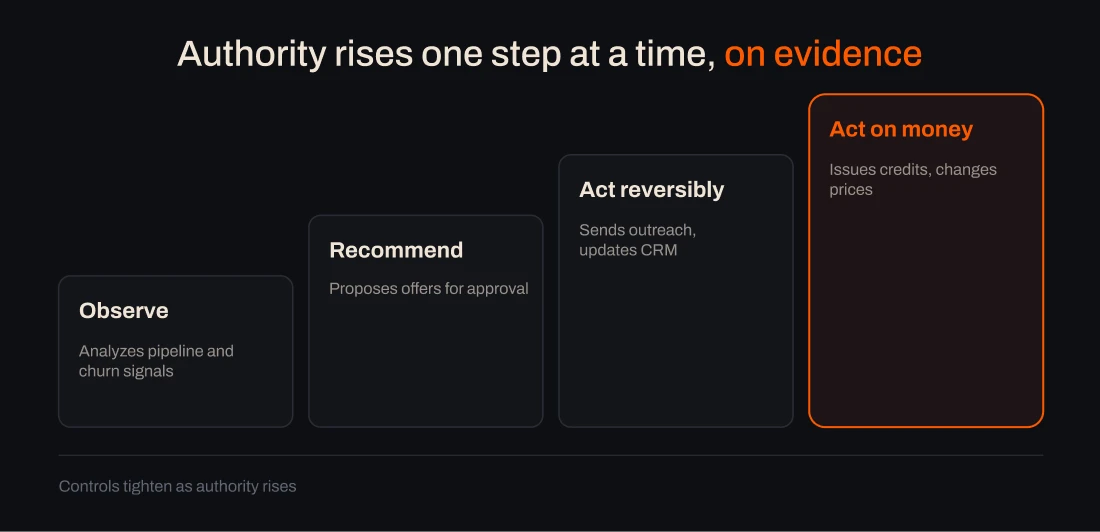
Agents move up the ladder one step at a time, and only on production evidence.
What Evidence Will a CFO Fund?
Funding should follow proof that the economics hold as volume, exceptions, and authority grow. Four tests make that case:
- Contribution against a baseline. Compare renewal rates, discount leakage, or days sales outstanding with a holdout group or the pre-agent period.
- Falling exception cost. Human review rates, retries, and rework should decline as the agent learns and policies stabilize.
- Clean control record. Monitoring should show every action stayed within permissions, dollar limits, and rollback rules.
- Cheaper next deployment. Shared data definitions, integrations, and guardrails should cut the cost of the next workflow.
The fourth test is easy to overlook, and it decides whether agents become a platform or a collection of projects. McKinsey identifies weak data foundations as the main constraint on scale. Teams that standardize customer, contract, and product definitions once let every later agent inherit them.
How Does An Operator View The Agent P&L?
At iOPEX, we embed agents inside revenue operations: renewals, quoting and CPQ, usage monetization, billing orchestration, and revenue leakage prevention. More than 1,000 of our Command Agents run in production across ServiceOps, RevOps, Finance Ops, Infra Ops, CX, and Media. Our commercial model is outcome-linked, with a declining cost commitment, and RevOps engagements are measured on revenue realization, margin, cash flow, and leakage. SuccessPilot, which automates retention, adoption, and expansion, has delivered a 15% renewal lift.
The agent programs that survive 2027 will look less like experiments and more like business lines. Each will have a P&L owner, a contribution metric, an authority level, and a production record that justifies the next step.
Bring one revenue workflow to the table. We will look at its economics, the authority it needs, and whether an outcome-linked model fits. Start a conversation with iOPEX.