


When AI Shapes What Customers Buy,
Brands Need Better Control
What Marketing leaders (brand or commerce) need to act on now?
- AI now builds the shortlist. Shoppers meet your product inside an AI answer, often before they reach your site.
- Product data decides inclusion. Inconsistent price, stock, and attributes across channels cost visibility at the moment of choice.
- Visibility is an early signal. AI referrals convert well, yet referrals capture only part of AI's influence on revenue.
- Budget needs causal proof. Attribution shows contribution. Incrementality shows whether spend created demand that would not have happened anyway.
- Fix product truth before scaling media. Paid activation amplifies whatever the AI already believes about your product.
Your next customer will likely meet your product inside an AI answer. More than 1 in 4 consumers already use generative AI to shop, according to McKinsey's State of the Consumer 2026. The traffic it sends is valuable. Adobe found AI referrals to US retail sites converted 54% better than other sources in May 2026.
The answer that the shopper sees is assembled from your feeds, retailer listings, reviews, and third-party content. Brand-owned sites rarely get cited directly, and consumer trust in generative AI sits below 40%. One wrong price or missing attribute can remove a product from the shortlist.
The stakes are large. McKinsey sizes US agentic commerce at up to $1 trillion in orchestrated revenue by 2030. Budgets are tight. Gartner reports marketing spend flat at 7.8% of company revenue in 2026.
That leaves leadership with two questions.
- Is AI representing our products accurately?
- Can we prove AI-influenced discovery creates revenue we would not otherwise earn?
The second depends on the first.
Where Does Product Truth Break Before an AI Recommendation?
AI assistants compare products using whatever data they can find. When brand systems, merchant feeds, retailer pages, and reviews disagree, the assistant hedges or moves on. Adobe's Q1 2026 benchmark found many US retail pages are still only partly readable by AI models.
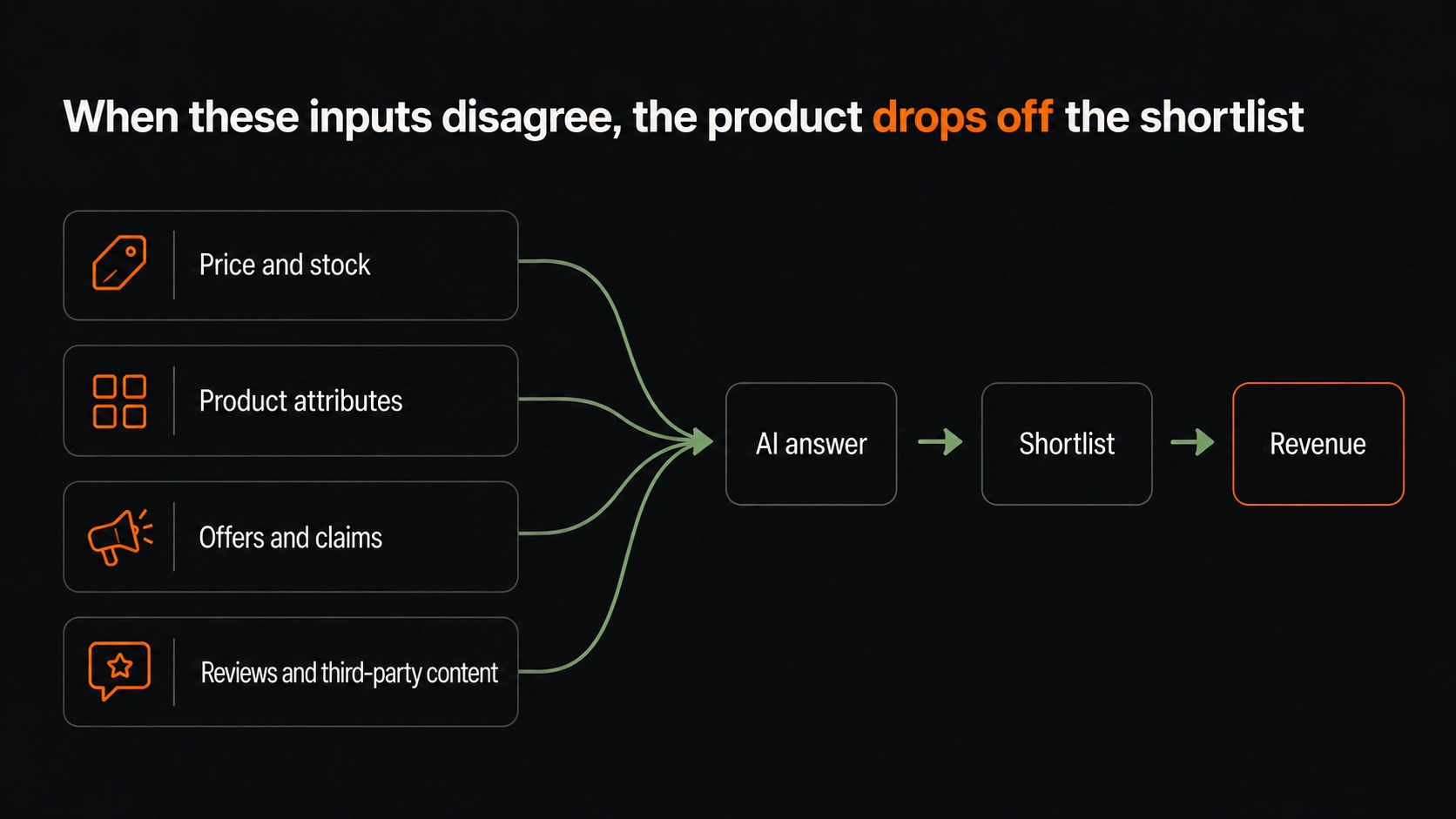
Four ongoing practices keep products visible:
- Synchronize what changes fastest. Keep price, inventory, and promotions aligned across PIM, commerce platforms, merchant feeds, retailers, and marketplaces.
- Describe products the way shoppers ask. Capture materials, dimensions, fit, use cases, and compatibility as structured attributes.
- Assign ownership for every claim. Timestamp offers, certifications, and claims, and name the team accountable for each.
- Monitor beyond owned channels. Track retailer listings, reviews, and high-authority third-party sources for conflicts with owned data.
Pricing, merchandising, ecommerce, and marketing all touch these inputs. One executive owner for cross-functional conflicts keeps fixes from stalling between teams.
Why is AI Visibility an Incomplete Revenue Metric?
AI referral traffic is the easiest signal to see, which makes it the easiest to over-read. It counts only the shoppers who click through from an AI answer, and many never click.
A shopper may use an AI assistant to narrow three options to one, then buy through:
- A direct visit or the brand app
- A marketplace or retailer site
- A physical store
None of those purchases carries an AI referral tag. Last-click reporting credits the final channel. Platform-reported attribution credits activity the platform can see. Both understate how much AI shaped the decision, and neither proves the decision would not have happened anyway.
The result is a gap between AI visibility and AI influence. A brand can appear often in AI answers without growing sales. Leaders need a way to tell the two apart before they fund either.
How Should Leaders Measure AI Influence Without False Precision?
Treat measurement as a chain, with separate evidence for each link.
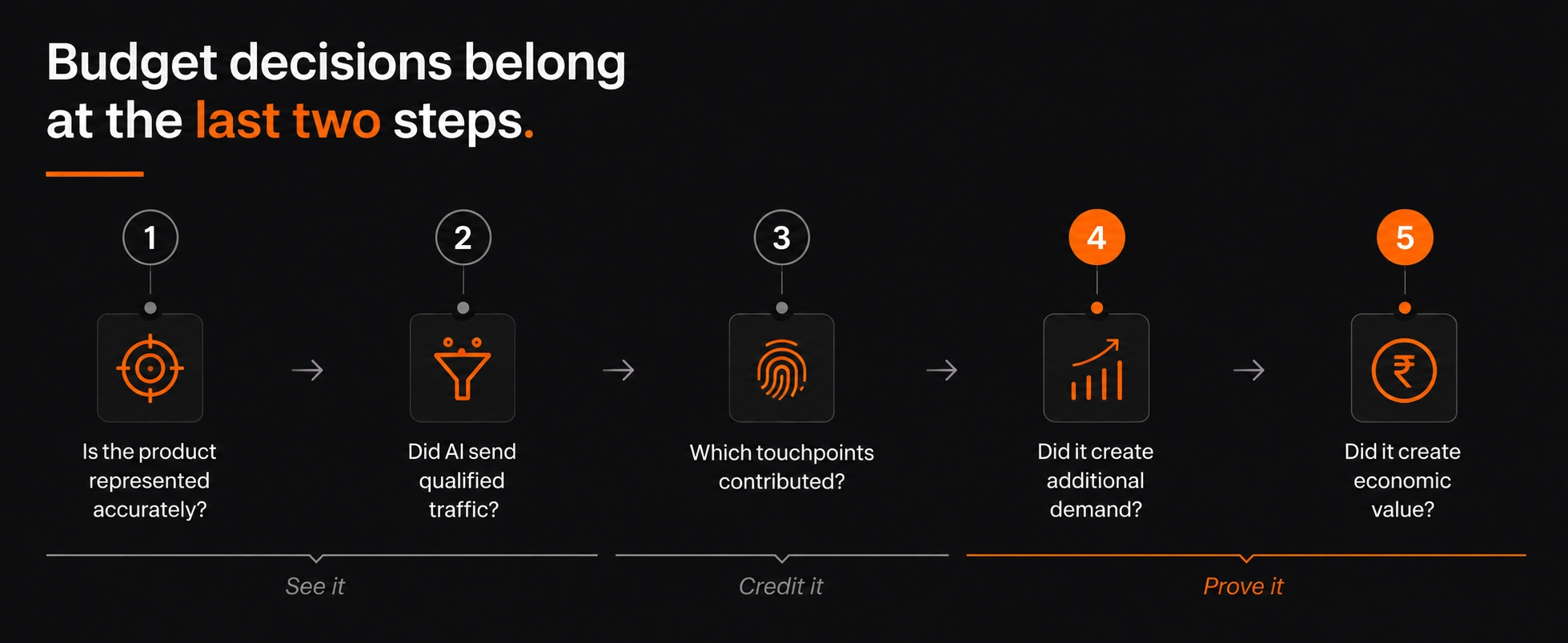
The first two links show whether AI can see the product and send shoppers. The third assigns credit across a journey that AI has compressed. Only the last two answer the CFO's question: did this spend create demand and margin that would not have existed otherwise?
Incrementality testing is what makes that answer defensible. A holdout or geo test compares exposed and unexposed groups, so the result reflects what the activity caused.
Where do AI Discovery Budgets get Misallocated?
Four patterns deserve executive attention before the next budget cycle.
- Treating AI citations as a growth KPI. Frequent inclusion signals discoverability. Funding still needs evidence of qualified demand and incremental sales.
- Treating product schema as a one-time project. Prices, stock, promotions, and reviews change daily. AI readiness is an ongoing data operation.
- Treating referral traffic as total AI impact. Clicks capture one slice of influence. Measurement design must account for direct, marketplace, and in-store purchases.
- Scaling media before data is ready. Paid activation pushes more shoppers toward whatever the AI already says about the product, accurate or not.
How iOPEX Turns AI Discovery Signals into Investment Decisions?
iOPEX works as the AI, engineering, and operations partner that connects readiness, activation, and proof in one operating cycle. Commerce and PIM teams keep ownership of product truth. iOPEX DemandPilot ensures campaigns scale only on inputs that are ready and measures every result against what would have happened without them.
DemandPilot runs that cycle through specialized agents:
- Campaign Readiness Agent checks data readiness, audience delivery, activation conditions, and control-group integrity before launch, so spend starts on a clean baseline.
- Omnichannel Activation Agent coordinates targeting, message sequencing, and budget pacing across approved channels.
- Performance Evaluation Agent assesses lift, attribution impact, and incremental performance against objectives and historical benchmarks. Significance testing shows whether a result is strong enough to act on.
iOPEX MarketingOps extends the cycle into budget decisions. It brings attribution, incrementality, budget reallocation, pipeline contribution, and real-time performance visibility into one view, so marketing and finance leaders work from the same evidence when they decide where the next dollar goes.
The starting point is one high-value product category where AI already shapes consideration. Three steps build the evidence a CFO will accept:
- Map product truth. Compare what feeds, retailer listings, reviews, and AI shopping surfaces say about the category. Flag every conflict and assign an owner.
- Design measurement before spend. Define how the team will track AI referrals, attribute cross-channel contribution, and run holdouts or geo tests.
- Fund what proves lift. Scale activation only where incremental revenue and margin justify it.
The brands that win AI-driven discovery will be the ones that can show the board what it earned.
Book an AI Discovery Measurement Review. We assess one priority category for product-data gaps and measurement blind spots and show where incremental revenue is being missed or misattributed. Let’s talk