


Every AI engagement runs on two clocks, and they no longer agree.
The first is the intelligence clock, and it runs fast. The world it keeps time with re-renders every quarter. Models improve, inference costs fall, automation tightens, and the cost of producing a unit of work keeps dropping. This is the clock an enterprise believes it is buying when it invests in AI.
The second is the contract clock, and it stopped years ago. It was set in a delivery world that was human, countable, and linear, priced on headcount, effort, and seats, and no one has reset it since. It still reads the time it read before the technology existed.
Run an engagement on both, and the enterprise is living in two different times. The intelligence clock races ahead. The contract clock holds. The gap between what the work now costs to produce and what the contract still charges for it widens every quarter, until the relationship breaks. Model quality has nothing to do with it.
We Keep Blaming the Model
S&P Global Market Intelligence found that the share of companies abandoning most of their AI initiatives before they reach production jumped from 17% to 42% in a single year, with the average organization scrapping 46% of its proof-of-concept projects before they scale. The industry's reflex when a program stalls is to diagnose the technology. Dirty data. Talent gaps. Change management. These are real constraints and worth solving. However, in most cases, they are second-order problems.
I have sat on both sides of these deals, and the more common culprit is the second clock. The pilot works. The contract around it was written for a kind of labor that the AI was brought to retire.
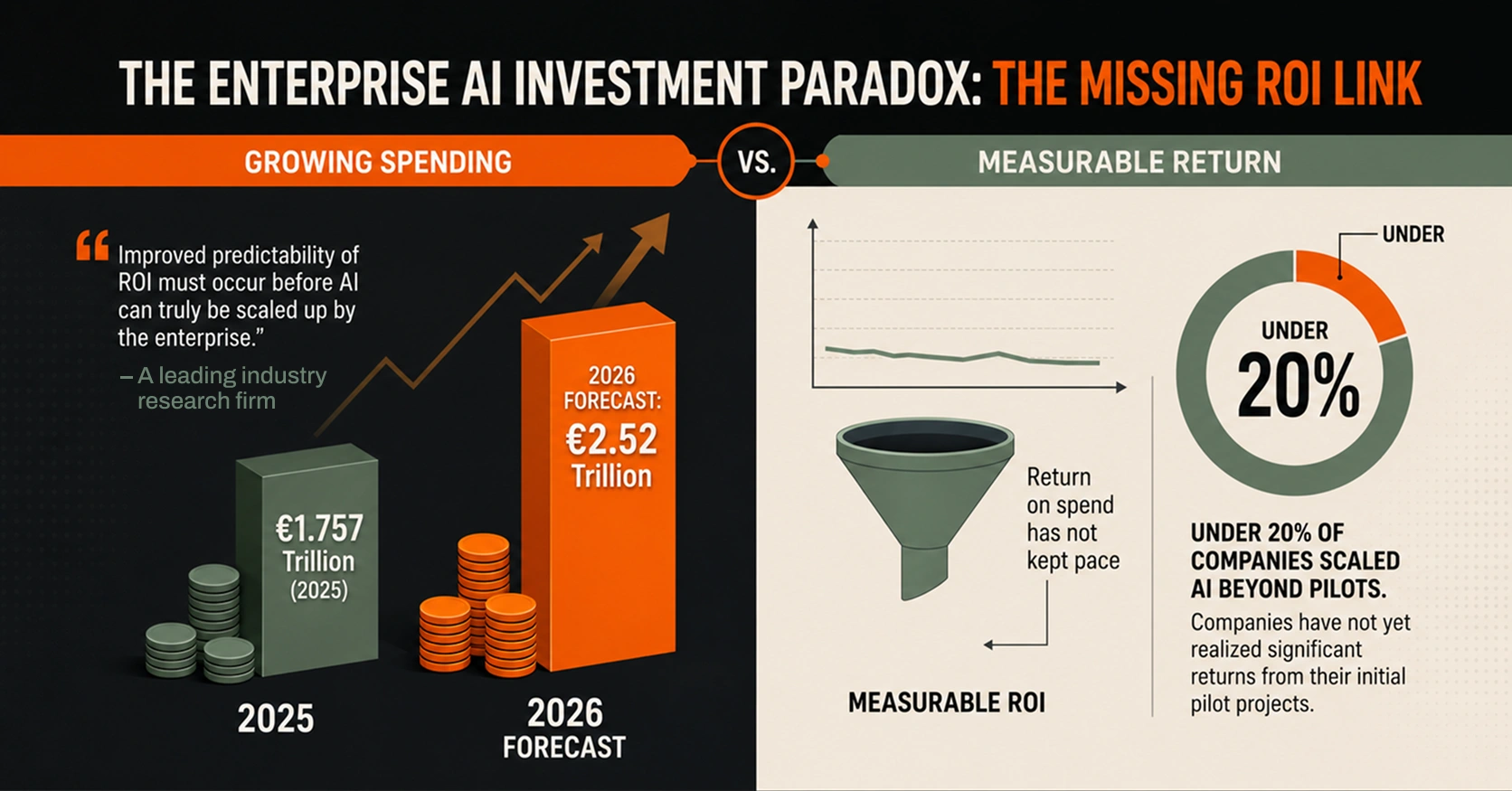
A provider paid per head has no financial reason to reduce heads. A provider whose SLA is measured on ticket volume has no commercial reason to eliminate tickets at the source. Every efficiency the AI creates attacks the number that the agreement was written to grow. The enterprise is paying to slow down the thing it is also paying to accelerate.
Gartner expects that pressure to ease only as the model itself changes, projecting that by 2027 the cost-to-value gap on process-centric service contracts will shrink by at least half through agentic AI reinvention. The enterprise AI ROI problem is substantially a contract design problem.
The Procurement Process Makes It Worse
Procurement compounds the problem because the buying instrument can only measure labor.
A traditional RFP evaluates day rates, headcount pyramids, and delivery locations with genuine precision. It has no instrument for intelligence quality, model adaptability, or outcome reliability under real operating conditions. The selection cycle still runs for months and ends in a scoring sheet calibrated for the price of people.
Saurabh Gupta, President of Research and Advisory Services at HFS Research, likens today's RFPs to "Netflix counting DVDs," multi-month selection cycles for an AI world that re-renders every few months. The capability is from this decade. The ruler measuring it is from the last one.
HFS built its AI-First Deal Lab to retire the beauty parade, framing the old model as endless RFPs, vendor pageants, and box-checking benchmarks. The Deal Lab runs on four principles:
- Research-led deal construction using real market benchmarks in place of vendor claims
- Workshop-driven co-design with business, IT, and procurement in the same room
- Problem-solving diagnostics and negotiation accelerators in place of RFP paperwork
- Future-ready contracts and governance built for model drift and regulatory change.
HFS frames the value AI should create around four levers it calls the 4 Ps: productivity, prediction, personalization, and performance.
The sequence moves from executive alignment through diagnostics, pressure-testing workshops, and commercial co-design to a readiness plan, and it runs in weeks where a traditional sourcing cycle takes months. The difference is structural. A procurement cycle gets replaced by a co-design sprint that produces a commitment with milestones in place of a report with recommendations.
The Honest Objection
Here is the objection I hear in every serious negotiation, and it deserves a serious answer.
Outcome-based deals are hard. Attribution is genuinely messy. If revenue improves, who gets the credit, the AI or the salesperson who finally followed up on the lead it surfaced? Vendors fear carrying risk they cannot fully control. Buyers fear paying a premium on a number they cannot fully verify. These are real problems. Everest Group calls attribution the central unsolved question in outcome-linked work, and they are correct.
That difficulty is a reason to get better at the harder commercial model, because the easier one has already started to destroy value. Pricing intelligence like overtime is no longer a safe default. It is now the expensive option. The market is not waiting for attribution to be perfectly solved before it moves. The Futurum Group's 1H 2026 survey of 830 enterprise software buyers found that 43% now prefer consumption-based pricing and 27% prefer outcome-based pricing, leaving fewer than 1 in 5 still committed to classic per-seat terms. The demand has already shifted.
A Deal Designed for Intelligence
A commercial structure built for AI rests on one principle: pay for the change in the business and fund the learning that produces it. Three things follow from that.
Pricing moves to verified results. The unit of value becomes the outcome the client can measure, a lower cost to serve, a recovered dollar, a resolved ticket, in place of the hours billed to produce it. The market already prices on this basis. Intercom bills its AI agent at $0.99 per resolution, Zendesk at $1.50, and Salesforce Agentforce at about $2.00 per conversation. Gartner expects the GenAI cost per customer-service resolution to climb above $3 by 2030, exceeding many offshore human agents as vendor subsidies end and complexity grows, which is precisely why the unit and its trajectory belong inside the contract.
Discovery moves to sprints. The long evaluation collapses into weeks of working diagnostics on real data from the actual operating environment. Value is proven before scale is contracted, rather than guessed at in a scoring spreadsheet.
Governance moves to drift. A learning system will not remain static within a static SLA. The agreement has to account for the model changing, improving, and occasionally regressing, and it has to price that motion in. That means continuous assurance across accuracy, drift, bias, hallucination rates, and retraining cycles, written into the deal structure rather than treated as an operational afterthought.
The first of these is the hardest and the most important, because it is the only one that aligns the two clocks. When the provider's economics rise and fall with the client's measured outcome, the contract clock finally tracks the intelligence clock. Gain-sharing is the mechanism. Shared measurement is the discipline that keeps it honest.
What We Have Built at iOPEX, and Why It Matters to You
Structural claims need operating evidence, not theory. At iOPEX, we made a deliberate decision - to stop selling delivery and start selling outcomes. Not as a positioning statement, but as a commercial contract.
Our Intelligence as a Service model rests on one commitment: that the client's cost declines progressively over the term while our revenue is tied to the business results we produce. HFS Research recognized the model in the HFS Horizons: Agentic Services 2026 report, recognizing iOPEX as a Horizon 2 Enterprise Innovator and citing its gain-sharing commercial model in agentic services.
The architecture behind that commitment is ElevAIte, our productized Intelligence as a Service platform. ElevAIte orchestrates domain-specific Command Agents across customer experience, field service, infrastructure, security, sales, marketing, and finance operations.
In production today, more than 1000 of our Command Agents handle over 50,000 autonomous events every month across telecom, retail, healthcare, hi-tech, and financial services. They do not sit behind traditional rate cards. They sit inside agreements that tie value to concrete operational indicators such as cost to serve, time to resolve, and revenue impact.
The pattern across these deployments is consistent. AI agents take over repeatable decision work, human teams move up to exceptions and judgment, and unit economics shift in ways that hold beyond the pilot window. Ticket volumes fall in some environments. Revenue per interaction rises in others.
What stays constant is the principle: the contract is designed to let those improvements exist and to share them, in place of letting them disappear into a utilization spreadsheet. That is what a Services-as-Software contract looks like in practice. The client commits to a result and an operating envelope. iOPEX commits to the intelligence, the orchestration, and the ongoing tuning that keep both clocks aligned.
Three Things to Do Before Your Next Renewal
The gap between where enterprise AI commercial models are and where they need to be is closing, but not automatically. It closes because individual executives decide to act on it.
Before your next contract renewal, audit what you are actually paying for. Pull the SLA schedule and identify every metric that measures activity rather than outcome. Count how many of those metrics would register as green even if the AI program were underperforming the business case. That number tells you how much governance slack the current structure permits.
Run a co-design sprint before your next procurement cycle, not a vendor evaluation. Bring your business owners, your technical teams, and two or three providers into a structured diagnostic workshop. The question is not who can describe the best solution. The question is who can prove results with your data, your process, and your constraints in a defined time window.
Insist on a production reference, not a case study. Any provider claiming outcome-based pricing can produce a customer reference for a contract that has been operating on those terms for at least 12 months, with attributable metrics, auditable baselines, and named business outcomes. If they cannot, the model is aspirational. You need it operational.
Technology is not your bottleneck. Your pilot proved that. What stops AI from scaling is the commercial structure it is trapped inside — contracts priced for effort, procurement designed for comparison, and governance built for a world where delivery was human and linear.
That structure is changeable. The enterprises already changing it are separating from the ones still debugging the technology.
iOPEX's Intelligence as a Service model is outcome-linked commercial architecture, already in production. To see how the deal structure is built, connect with the iOPEX team.