

Your Mean Time to Resolution (MTTR) has likely stayed flat for three or four quarters. The investment was real: scheduling tools, dispatch optimization, new training modules, and more technicians. Operations reviews still dissect response time, travel time, and wrench time. The metric still refuses to move.
Most field service leaders measure MTTR from the start of the repair to the moment the asset returns to service. That window hides the most expensive part of every visit: the time spent assembling context before any repair begins.
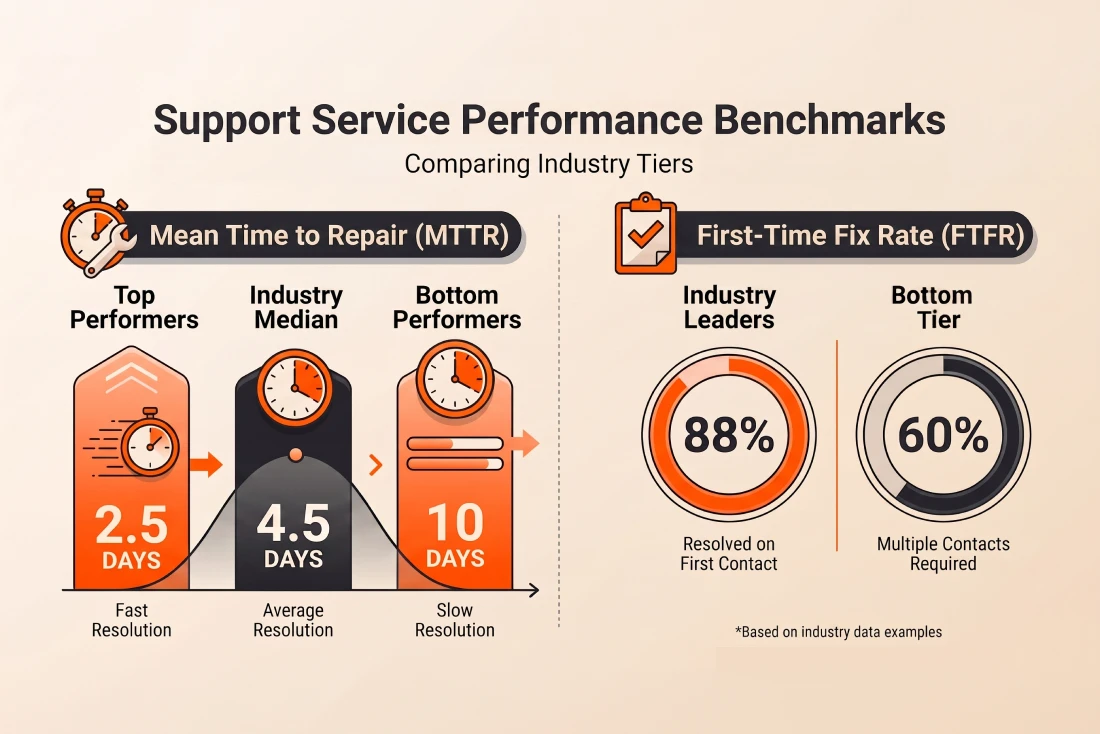
The gap between leaders and laggards shows how much is at stake. A 2026 field service KPI benchmark analyzed nearly 30 million service events across 161 organizations. Industry median MTTR is 4.5 days. Top performers close cases in 2.5 days. Bottom performers take 10 days. First-time fix follows the same curve, at 88% for leaders and 60% for the bottom tier.
The equipment is often comparable. What differs is how expertise travels. The same benchmark measured the first-time fix gap between star technicians and everyone else at 2.9 points in best-in-class teams and 10 points in underperforming ones, where critical knowledge stays with a few people.
Context gathering is active work that produces no repair progress. A technician searching disconnected systems for a part number is busy. That effort creates no value for the customer.
The hidden time sinks inside MTTR typically fall into four categories.
Why Do Faster Dispatch and Scheduling Tools Fail to Reduce MTTR?
The default response to high MTTR is to push technicians through the field faster. Leaders invest in routing, tighter arrival windows, SLA controls, and performance reviews. These moves improve response time. They rarely change repair outcomes.
Arrival is one stage of resolution. A technician can reach the site on time and still lack diagnostic history, asset context, parts confidence, or a proven resolution path. MTTR expands after arrival.
First-time fix exposes the problem more clearly than dispatch speed. Failed visits account for 25% of total service cost at the median and 44% among bottom performers, according to the same benchmark. Top performers hold that figure to 14%. Every return trip restarts coordination, consumes another technician slot, and extends customer downtime. The benchmark also found that one in five cases could be resolved remotely, yet teams still roll a truck.
The stronger MTTR strategy prioritizes context over speed. Before every dispatch, leaders should be able to answer three questions. Does the technician know what failed? Which parts matter? What did previous visits reveal?
How Does Lost Technician Context Reset Repair Progress?
Shift changes reset repair progress because diagnostic context does not travel with the work order. The incoming technician may know the asset and still miss what was tested, ruled out, or nearly resolved. That gap forces repeat investigation and turns an almost complete repair into another extended MTTR event.
- Prior diagnostic notes remain buried in work orders rather than guiding the next on-site decision.
- Incoming technicians repeat tests because earlier findings never become usable repair context.
- Senior technicians carry resolution logic the wider field team cannot access.
- Workforce churn and retirements remove expertise before any system captures it.
- Multi-visit jobs lose momentum when handovers record status and omit decision history.
- MTTR dashboards understate the damage because each assignment appears as a separate event.
Retention data puts a number on the risk. Top-performing service organizations retain 87% of their workforce, compared with 66% for bottom performers, the same benchmark shows. When context lives in people and scattered records, every departure and every handover becomes a failure point. The fix is decision continuity across shifts, technicians, and visits.
Why is the Context Gap an Operational Architecture Problem?
The real barrier is architectural. Most field service organizations run operations across several disconnected platforms. Each holds part of the picture.
No single system delivers a unified picture at the point of work. Technicians assemble context during live service windows, opening the CRM, ERP, FSM platform, knowledge base and asset system one by one. The search looks like normal work. It delays the repair decision and increases the risk of errors.
The 2026 benchmark data points the same way: organizations that connect their systems and service data into a unified intelligence layer consistently outperform those running in silos.
Parts identification shows how the architectural gap translates into measurable delay. Technicians must identify the component, cross-reference catalogs, verify compatibility, and check inventory before the next repair decision. iOPEX FieldPilot was built to remove that friction. In a flagship deployment for a global retail technology provider, parts identification time fell from 30+ minutes to about 8 seconds, and parts lookup accuracy reached 100% in production.
The gain came from removing manual context assembly altogether. An agentic intelligence layer already knows the asset, the fault history, the compatible parts, and the nearest available inventory.
What Changes When Technicians Receive Context Before They Arrive?
Field service economics shift when enterprises move from reactive context assembly to proactive context delivery. iOPEX FieldPilot sends each engineer a pre-diagnostic briefing with the likely fault mode, the confirmed parts list, and a step-by-step resolution path before they leave the depot.
In the retail technology deployment, that model produced a chain of downstream results:
- Escalations fell 28%. Weekly helpdesk calls dropped from 519 to 372 as the knowledge agent surfaced resolution paths that once required a senior engineer.
- Onsite repair time fell by about 15 minutes per visit, improving customer uptime and lowering cost per job.
- Technician onboarding ran 50% faster because new hires reached the institutional knowledge that once took years of field experience to build.
- Productivity rose 14% among high-frequency users, from 3.5 to 4 tasks per technician per day.
- First-time fix improves because technicians arrive with the right parts and the right diagnosis, removing the main causes of return visits.
These are production results from one enterprise program: 1,000 field engineers live within 12 weeks of contract signing, running at 92% overall AI accuracy from week one. FieldPilot integrates with existing systems of record through pre-built connectors for ServiceNow, Salesforce, SAP, and major ERPs. The benchmark figures earlier in this article are cross-industry market data from a 2026 industry benchmark of 161 service organizations. The FieldPilot figures are verified results from a single deployment.
How Should Field Service Leaders Rethink MTTR Strategy?
Stop treating MTTR as a technician speed metric. The critical question is whether every technician has the right context before making a repair decision. When context improves, speed becomes an operational outcome instead of a management demand.
Spending is rising. Grand View Research projects the field service management market will grow from $6.7 billion in 2026 to $13.8 billion by 2033. Much of that budget still goes to faster routing, tighter scheduling, and broader reporting. Those moves improve visibility. They rarely change what happens during the repair.
Three measures reveal the context gap faster than MTTR alone:
- Repeat-visit rate by fault code. Recurring faults with high revisit rates point to diagnostic history that is not reaching the field.
- Time from arrival to first repair action. A long interval means technicians are assembling context on the customer’s clock.
- Escalation rate by technician tenure. A steep gap between new and senior staff shows how much expertise resides in people rather than in systems.
FieldPilot agents move service operations from reactive execution to assured outcomes. They embed intelligence directly inside existing field service workflows, so every technician works from the same context at the point of repair.
FieldPilot does not replace existing field service platforms. Its coexistence architecture integrates with current systems of record and delivers intelligence where those systems end. With 16 orchestrated AI agents, 500+ workflows, and 50+ KPIs across 8 operational segments, it covers the full lifecycle of a service visit, before, during, and after. Leaders stop measuring repair delay after the fact and start preventing context gaps before they reach MTTR.
Talk to iOPEX to assess where context breaks down in your field operation and what closing that gap would do to your MTTR in the next planning cycle. Explore iOPEX Field Services Operations for the wider operating model.
Frequently Asked Questions
1. What is MTTR in field service?
Mean Time to Resolution (MTTR) is the average elapsed time from when a service issue is logged to when the asset is fully restored. It includes diagnosis, parts, travel, and any repeat visits. A 2026 industry benchmark puts the industry median at 4.5 days, with top performers at 2.5 days.
2. Why does MTTR stay flat after dispatch and scheduling upgrades?
Dispatch tools shorten the time to arrival. Most MTTR accumulates after arrival, when technicians lack diagnostic history, parts certainty, or a resolution path. Failed visits then add further trips and days to each case.
3. How does first-time fix rate affect MTTR?
Every failed first visit restarts the resolution clock with a new dispatch. Industry benchmark data for 2026 shows failed visits account for 25% of total service cost at the median and 44% among bottom performers, which makes first-time fix the strongest single lever on MTTR.
4. How does agentic AI reduce MTTR in field service?
Agentic AI connects CRM, ERP, FSM, knowledge base, and asset data into one intelligence layer. It prepares a pre-visit briefing with the likely fault, confirmed parts and a resolution path, then guides the technician on site. In one iOPEX FieldPilot deployment, this cut onsite repair time by about 15 minutes per visit and escalations by 28%.
5. Does FieldPilot replace an existing FSM platform?
No. FieldPilot works alongside platforms such as ServiceNow, Salesforce and SAP. It uses them as data sources and adds reasoning, prediction and guided action on top.