


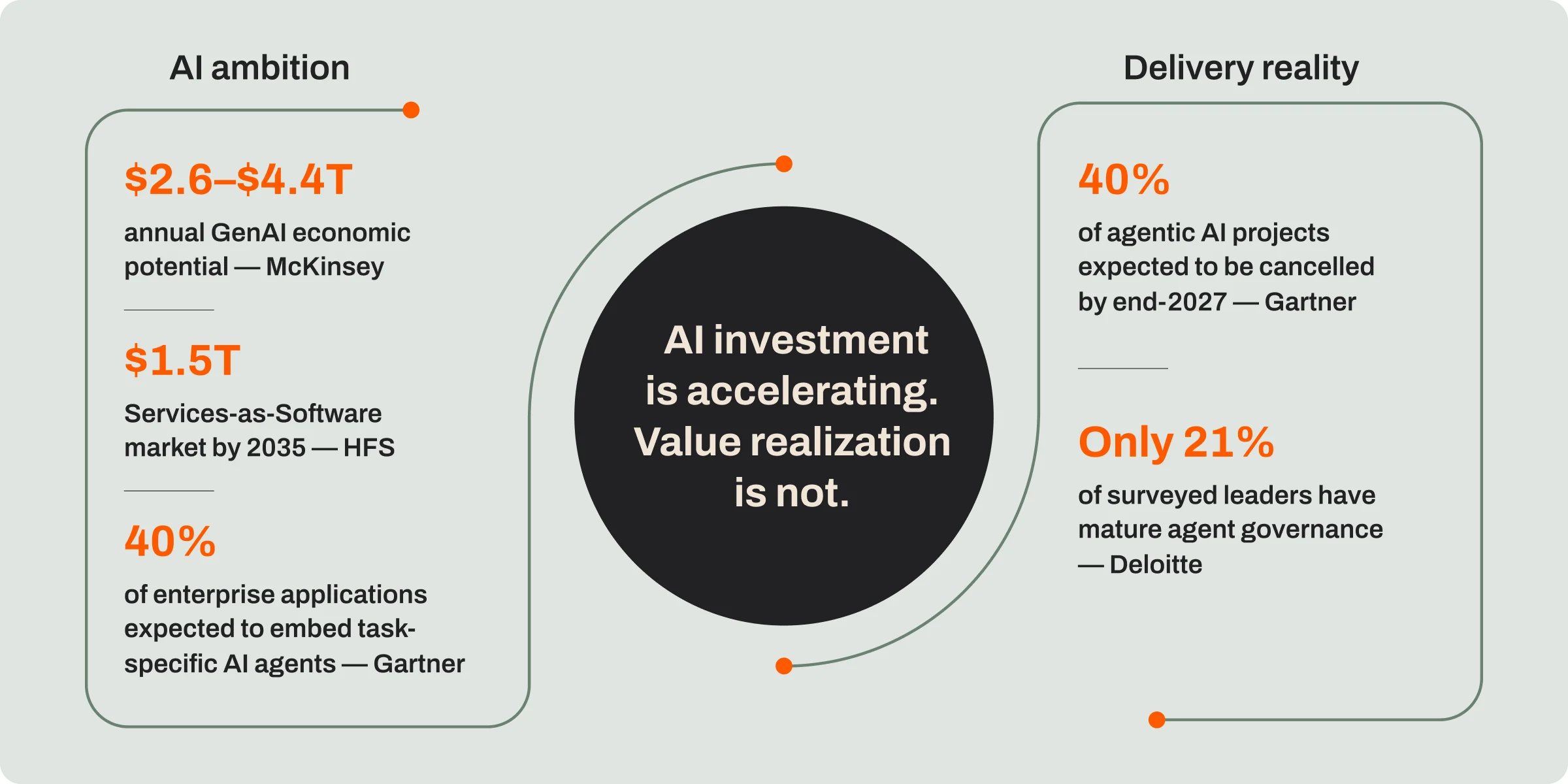
Every major enterprise has placed its AI chip. McKinsey pegs the annual economic potential of generative AI at $2.6 to $4.4 trillion. HFS Research sizes the Services-as-Software market at $1.5 trillion by 2035. Gartner forecasts that 40% of enterprise applications will embed task-specific AI agents by the end of this year, up from under 5% in 2025. These are the field reports of a reordering already underway.
And yet 40% of the agentic AI projects will be canceled by the end of 2027, according to Gartner, killed by escalating costs, unclear value, and weak governance. Deloitte surveyed 3,235 leaders across 24 countries and found that only 21% have a mature governance model for the agents they're already running. The gap between declaration and delivery is not closing on its own.
I have watched this pattern before - in cloud, in SaaS, in analytics. The technology arrives, the budgets follow, and then most organizations stall because they treated adoption as a technology project instead of a growth architecture decision. The constraint was never the model. Intelligence is cheap and getting cheaper. An AI interaction today costs $0.25 to $0.50. What separates the enterprises that compound returns from those that write off pilots is one thing: who owns the outcome, and how it is priced.
What Production Actually Looks Like
Three deployments across entertainment, healthcare, and field services show what production-grade agentic AI actually delivers when the architecture is right.
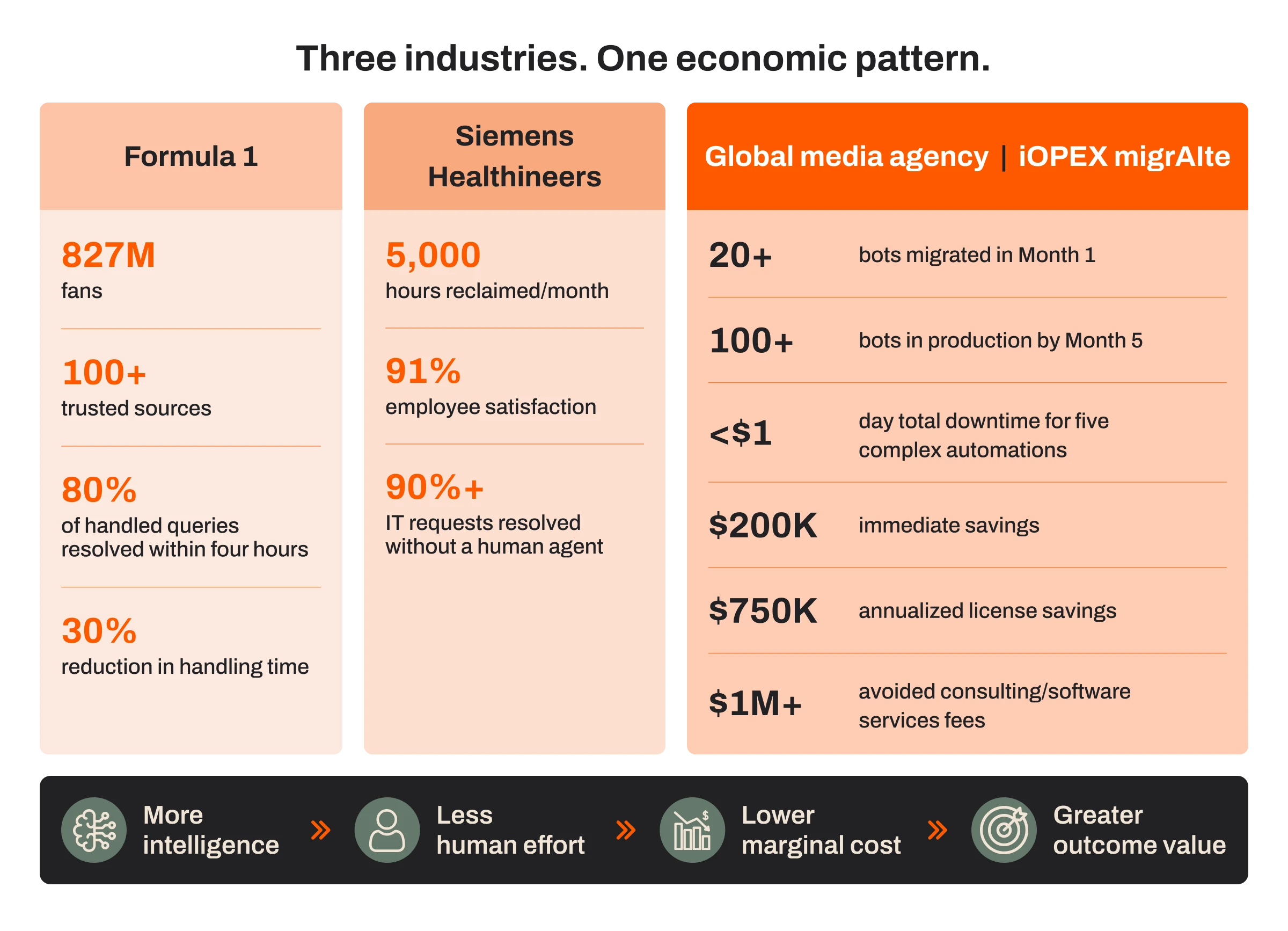
Formula 1 serves 827 million fans. The 2026 season brought the sport's most significant technical regulation overhaul in years, and every one of those 827 million people had questions. F1 deployed an AI fan companion agent built on Salesforce Agentforce, drawing on more than 100 trusted sources, monitoring trending queries in real time, and resolving 80% of queries handled within four hours, while cutting handling time by 30%. The agent doesn't just answer questions. It gets sharper with every conversation, and its cost curve declines as volume rises.
Siemens Healthineers operates under a different kind of pressure. Regulated healthcare, 74,000 employees, zero tolerance for governance failure. The company deployed an AI employee assistant on ServiceNow's autonomous workforce platform and reclaimed 5,000 hours every month. Employee satisfaction reached 91%. The platform now resolves more than 90% of IT requests without a human agent. The argument that autonomous AI cannot function inside compliance-sensitive environments has been retired.
A global media agency serving Fortune 500 brands faced a different problem entirely. Its automation estate had spread across multiple RPA platforms over years of separate projects. License costs climbed. Every new automation costs more than the last. Much of the original business logic existed nowhere but in the memory of people who had already left. A conventional migration was quoted in years and staffed in bodies. iOPEX deployed migrAIte, its agentic AI migration platform, to consolidate the estate onto Power Automate Desktop.
Twenty-plus bots moved in month one. The five most complex automations moved in month two, with less than a day of total downtime. More than 100 bots were in production by month five. The result: $200K in immediate savings, $750K off annualized license spend, and more than $1M that would otherwise have gone to consulting and software services fees. Twelve automations were handed to citizen developers. The program did not bill for a year of effort. It delivered an outcome in five months.
Different industries, different pressures, same lesson: the moment intelligence does the work, effort stops being a defensible unit of price.
The Economics of Orchestrated Intelligence
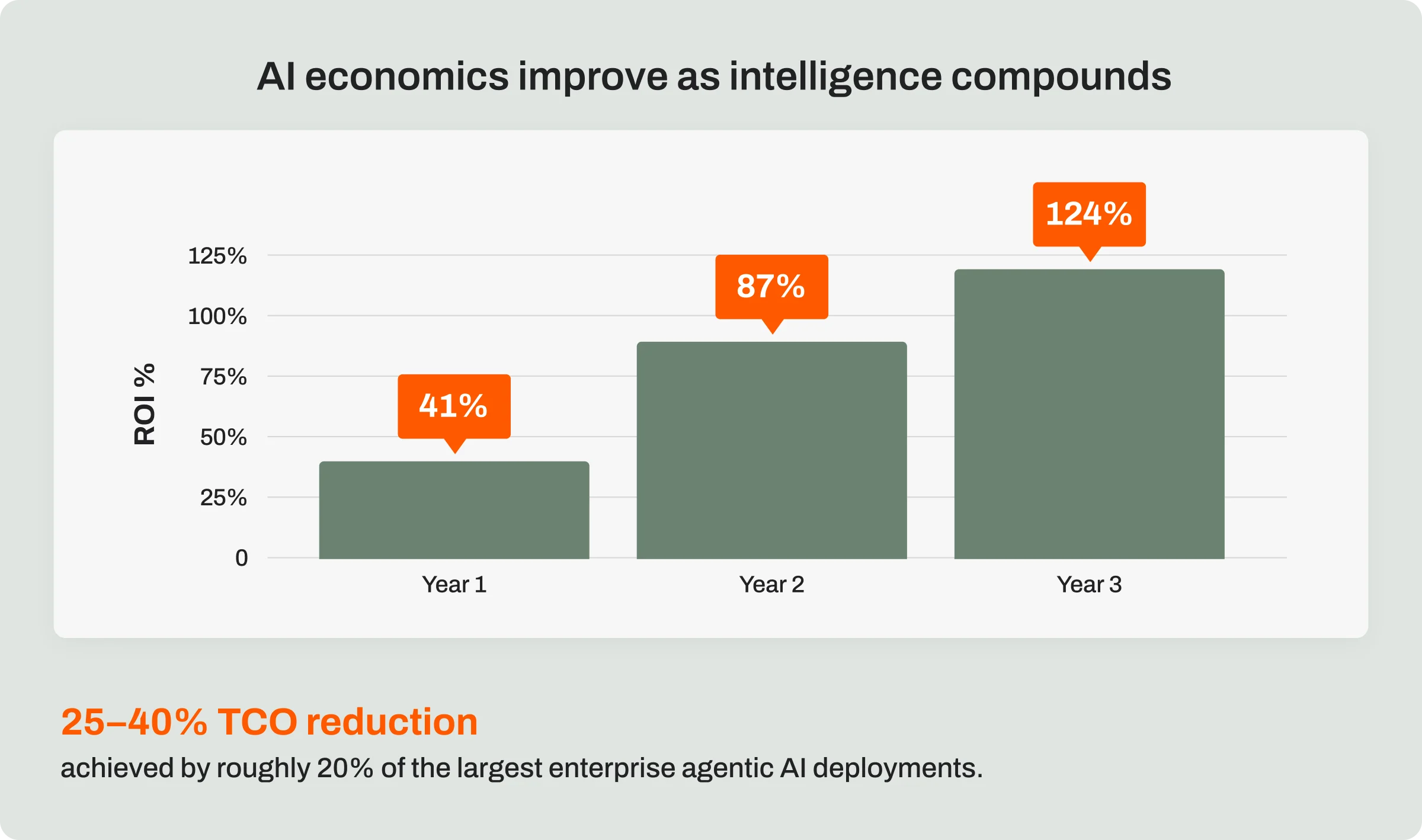
ROI on agentic AI compounds. Year one returns an average 41%. Year two, 87%. By year three, 124% or higher — because agents accumulate operational knowledge, improve accuracy, and run the same tasks at a declining marginal cost. BCG's analysis of the largest enterprise deployments finds that roughly 20% have already achieved a 25% to 40% reduction in total cost of ownership through agentic AI.
TSIA frames the inflection point with precision: seat-based SaaS economics are breaking. If one AI agent performs the work of five employees, a per-seat model becomes self-defeating. Revenue shrinks precisely when AI delivers more value. The enterprises that survive this shift are redesigning their commercial architecture around outcomes — tickets resolved, SLAs met, parts found, engineers deployed, fans answered. Companies using outcome-based pricing components report 31% higher customer retention and 21% higher satisfaction.
"You are not living through a typical technology shift," writes TSIA. "This moment is bigger than the cloud. Bigger than SaaS."
The Objection Worth Taking Seriously
Outcome pricing is not free of friction, and pretending otherwise is how these arguments lose credibility with the people who sign contracts.
Three objections come up in every serious negotiation.
- Attribution: when revenue moves, who caused it.
- Baselines: a provider paid on improvement has an incentive to negotiate a soft starting point.
- Measurement: the instrumentation required to price on outcomes is itself a cost, and most enterprises do not have it.
None of these are reasons to stay on effort-based contracts. They are reasons to do three things before signing one. Agree the baseline with a third party. Define the measurement layer before the commercial terms, not after. Start with outcomes that are already instrumented — resolution rates, license spend, cycle time — rather than outcomes that require new telemetry to observe.
Enterprises that skip this end up in the 40% Gartner is counting.
The Compounding Advantage of Intelligence As A Service
At iOPEX, we promise outcomes at a cost that declines every quarter. That commitment shapes every architectural decision we make.
The foundation is ElevAIte, our GenAI and MLOps platform, designed not as a toolkit but as a productized delivery model - what we call Intelligence as a Service. On top of it sit Command Agents: purpose-built agentic suites across CX, field service, IT ops, sales, finance, and marketing operations. These agents don't just automate tasks. They sense, decide, and act across complex enterprise systems with embedded AIOps intelligence and human-in-the-loop assurance. The result isn't a faster version of the old workflow. It's a fundamentally different cost curve where every interaction makes the next one cheaper and more accurate.
For enterprises still locked into legacy automation stacks, migrAIte, our AI-powered migration engine, accelerates the transition to modern platforms without disrupting live operations. Because the compounding advantage of agentic AI only kicks in when organizations can actually get there.
In March 2026, HFS Research recognized iOPEX as a Horizon 2 Enterprise Innovator in its Horizons: Agentic Services report, validating the company's ability to deliver agentic AI at enterprise scale. HFS Executive Research Leader David Cushman put it plainly:
"iOPEX is bringing domain expertise, technical acumen, and a strong win-win gain-sharing game to agentic services. And, as you'd expect of the firm's Ops DNA, a robust framework for AgentOps."
That is precisely the model the Outcome Economy rewards.
The Only Question Left
The math is no longer in dispute. The technology is no longer in prototype. The enterprises running production-grade agentic AI are already compounding returns, not because they picked the right vendor, but because they made an architectural commitment before the rest of the market caught up.
Every quarter spent in pilot mode is a quarter of compounding handed to a competitor.
Growth leaders who understand this are asking a different question now. Not, should we invest in agentic AI? That debate ended the moment F1 resolved 80% of queries handled within four hours, and a migration program scoped in years closed in five months.
Consider what migrAIte does to our own revenue. It removes months of billable effort from a program we would otherwise staff and invoice. In an effort economy, building it would be irrational. In an outcome economy, it is the only rational thing to build.
That is the test worth applying to any partner on your shortlist. Do their tools reduce what they can charge you? If the answer is no, they are still selling effort, whatever the contract calls it.
The only question worth asking in 2026 is: who in your organization owns the outcome?
In the Outcome Economy, accountability is the only competitive advantage that compounds.