


AI has made campaign creation fast. The work that follows creation, from trafficking and QA to pacing, reconciliation, and billing, is where many marketing organizations now absorb the cost.
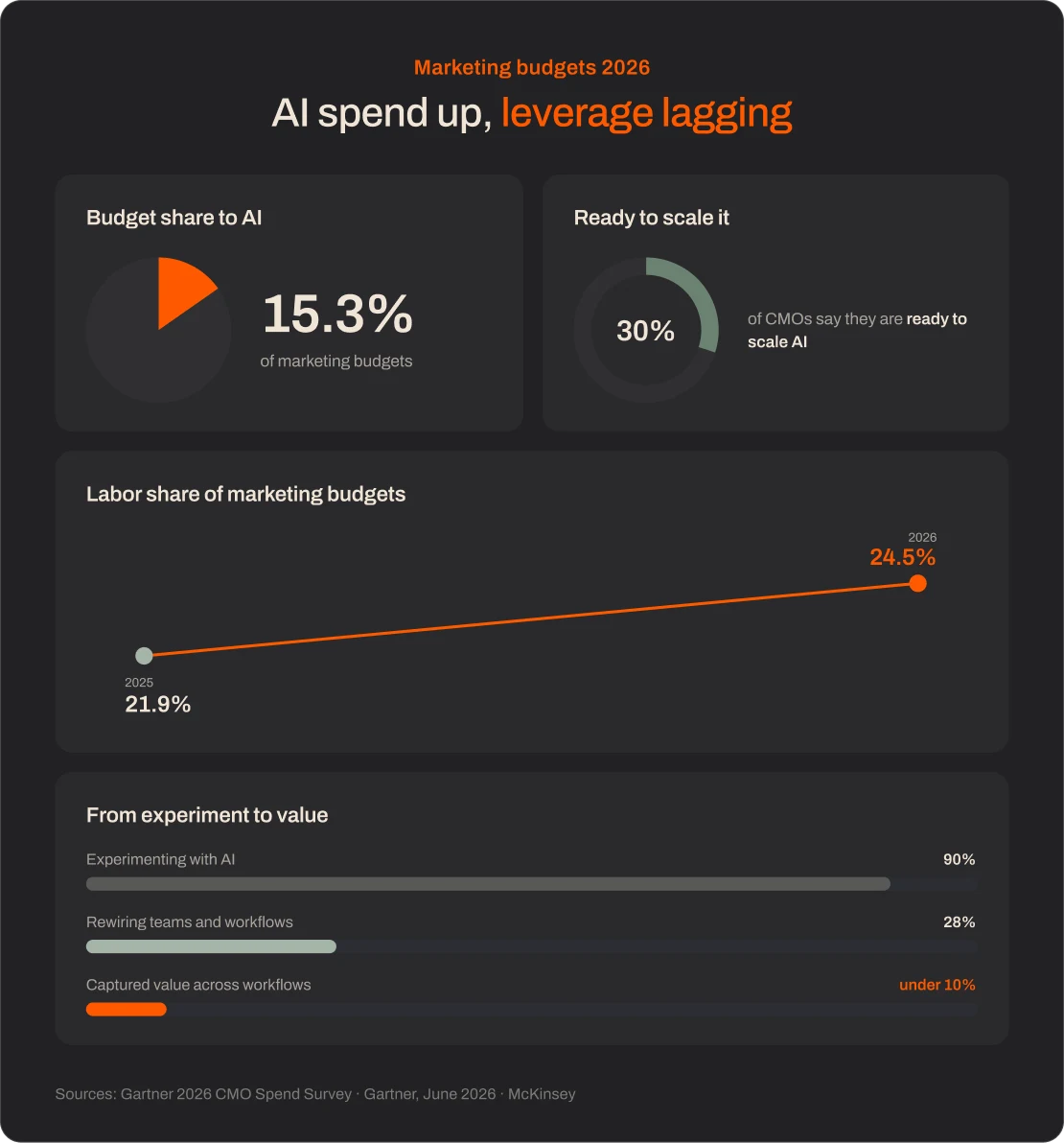
Budgets reflect it. Gartner's 2026 CMO Spend Survey found that CMOs allocate 15.3% of marketing budgets to AI, yet only 30% say they are ready to scale it. In the same year, labor's share of marketing budgets rose from 21.9% to 24.5%. AI alone did not drive that rise. It does show that technology spend has yet to produce automatic operating leverage.
CMOs need a harder efficiency test: does each additional campaign cost less to launch, manage, correct, and close?
Why Can Faster Campaign Creation Raise Operating Costs?
Most AI business cases start with task productivity. Creative is faster, setup needs fewer manual steps, and reporting takes less analyst time.
The next effect gets less attention. Faster upstream production creates more campaigns, creative variants, audience combinations, and optimization decisions for downstream teams to process. Campaign supply grows faster than the operations that support it. This is the throughput paradox: AI lowers the cost of creating campaign work and raises the volume AdOps must absorb.
What Does the Average Cost per Campaign Hide?
Mature recurring campaigns pull the average down. New channels, formats, markets, and approval rules make marginal work steadily more expensive. CMOs need four views.
If campaign volume grows 30% while operating cost grows almost as fast, higher throughput has produced little leverage.
Where Does the Extra Work Land?
The paradox appears wherever one stage accelerates faster than the stages around it.
- Creative review. Faster creative raises review volume when compliance and platform-spec checks stay manual.
- Trafficking. Automated campaign builds create pressure when channel setup and QA sit in separate teams.
- Activation. More audience variants add complexity when taxonomy and targeting rules differ by platform and market.
- Reconciliation. Automated reporting adds work when finance still resolves delivery discrepancies by hand.
Why Does the Exception Tax Matter More Than the Automation Rate?
Automation rates measure the happy path. Campaign economics depend on what happens when that path breaks. A missing asset, an unusual targeting request, a failed QA check, a pacing anomaly, or a late commercial change can return a campaign to manual handling.
CMOs should calculate an exception tax: the share of operating effort consumed by campaigns that leave straight-through execution. Track how often campaigns complete without unplanned intervention, which stages generate repeat exceptions, what each exception category costs in specialist time, and which exceptions reveal process gaps rather than genuine edge cases.
Where Should CMOs Apply AI First?
McKinsey's research shows the scale gap: 90% of CMOs are experimenting with AI, while fewer than 10% have scaled it or captured value across marketing workflows. Only 28% are rewiring teams and workflows.
Prioritize by economic impact. Start where high volume meets high manual effort: intake, trafficking checks, pacing reviews, and reconciliation. Then target stages with high exception cost, since removing 10 minutes from every campaign can be worth more than automating an occasional specialist task. Check downstream capacity before accelerating upstream production.
Which Metrics Prove AdOps is Scaling?
- Marginal campaign cost each quarter, to confirm added volume costs less to absorb.
- Straight-through completion rate from validated intake to execution.
- Exception cost by workflow stage, to locate where specialist judgment consumes capacity.
- Campaign volume growth against AdOps cost growth. The widening gap between the two is the clearest evidence of leverage.
How Does iOPEX Build Campaign Operating Leverage?
At iOPEX, we treat AdOps efficiency as an end-to-end operating problem. Our Media Monetization practice covers planning, activation, trafficking, optimization, reporting, and billing, with experience across more than 200,000 campaign launches and 4.6 million trafficked creatives.
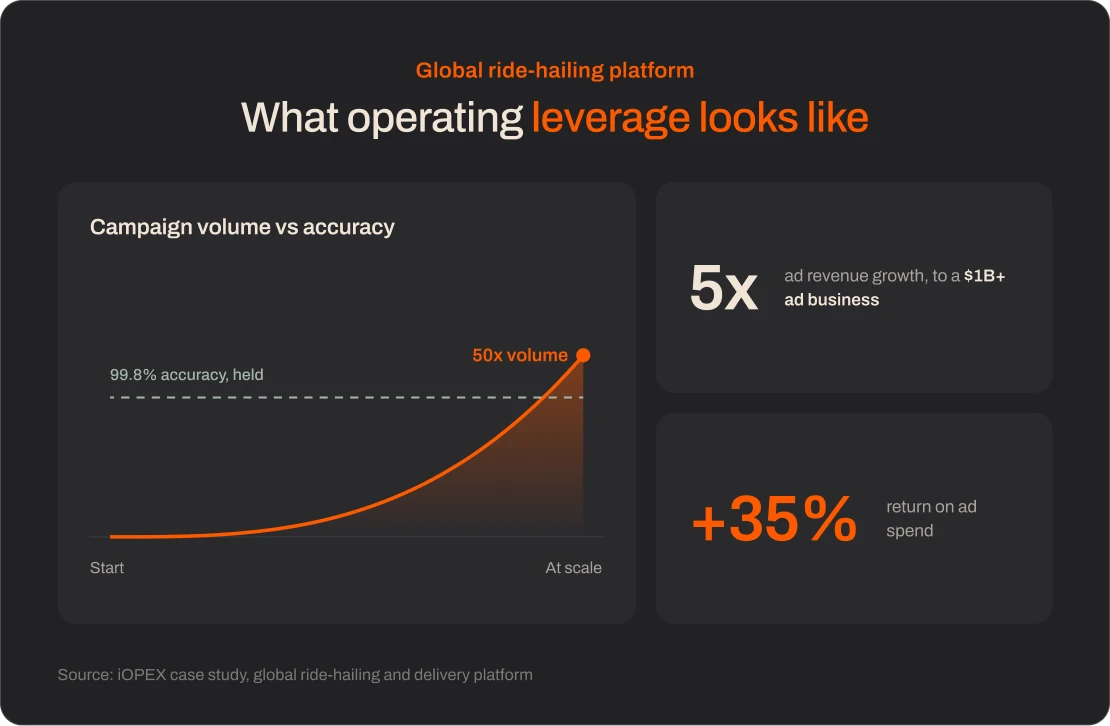
The results show what bending the cost curve looks like. One of the world's largest ride-hailing and delivery platforms built a $1B-plus ad business with iOPEX. Campaign volume grew 50-fold while accuracy held at 99.8%, ad revenue grew fivefold, and ROAS rose 35%. A global food delivery platform achieved 30% higher operational efficiency, and a native advertising platform reached 100% campaign accuracy.
DemandPilot takes the model into agentic execution. Its Campaign Readiness Agent validates activation, audience delivery, control groups, and data before spend begins, which stops exceptions at the source. Its Omnichannel Activation Agent launches across channels from a single instruction, removing trafficking handoffs. Plan-to-measurement cycles run up to 10 times faster, validated against your own data warehouse.
Start with one quarter of the campaign data. Calculate fully loaded AdOps cost, separate standard execution from exceptions, and model the next quarter at higher volume. Talk to our team to find where campaign growth is creating leverage and where hidden costs are scaling with it.